Why AI Agents Reward Infielders, Not Aces
I was listening to Charles Lamanna on Soma’s Founded & Funded podcast on Monday , and his point about despecialization really hit home.
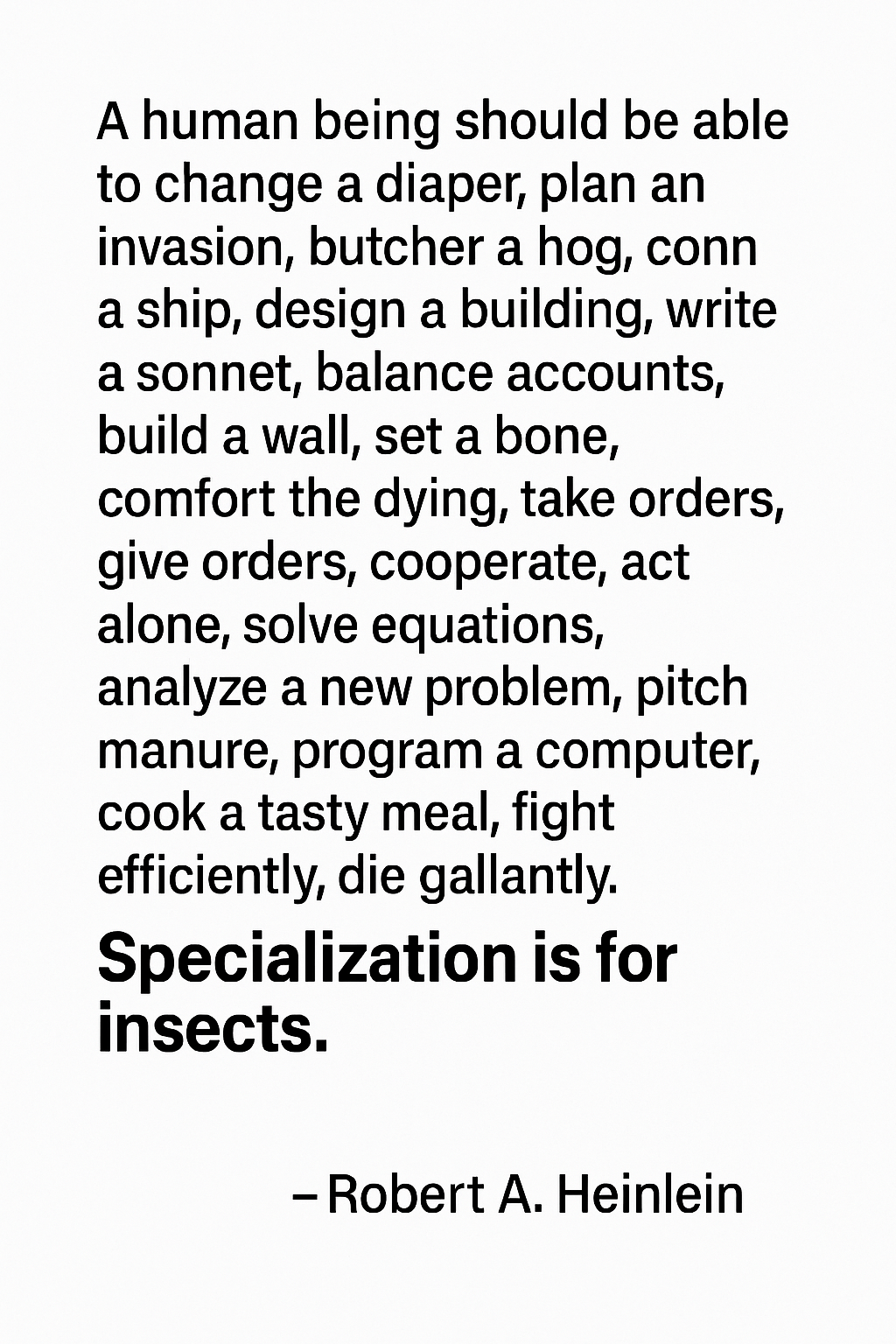
It’s rare that a single comment ties together your career, your instincts, and your favorite bookshelf reads. But this one did. Charles argued that AI is shifting value away from hyper-specialized skills and toward flexible, cross-disciplinary thinking. Generalists—what I’d call “infielders”—are suddenly in demand.
And I couldn’t nod hard enough.
A Bias, Confirmed
To be fair, this plays into every bias I have. I’m a self-identified “just enough depth to be dangerous” operator. My value hasn’t come from mastering a narrow domain, but from stitching together patterns across finance, tech, operations, change management, sales, and many others. Reading Range by David Epstein felt like someone had written my career into a defense memo. Lamanna just gave it a business case.
Why now?
Because AI agents are replacing the white-collar specialists.
- Not the CMO, but the copywriter.
- Not the VP of Data, but the analyst building dashboards.
- Not the strategy consultant, but the associate churning slides.
Tasks that once demanded focused expertise can now be delegated to AI agents—faster, cheaper, and increasingly better. When that happens, the edge shifts to the person who can connect those outputs, not just create them. Can think of how to use them in new and different ways. Generalists who know enough to be dangerous across multiple domains are the new integrators.
Agents Accelerate the Shift
We’re not seeing a skills apocalypse. We’re seeing a redistribution. The person who was great at “one thing” now shares that lane with an agent. But the person who can see across lanes, adjust the play, and call the audible? That person is now running the whole offense.
This reframes the AI conversation. The goal isn’t to master every model or become an AI prompt savant. It’s to build systems of agents—and then figure out how to manage those systems with judgment, context, and creativity.
That’s not about coding. That’s about ownership.
A Nod to Jocko
It’s no coincidence that both Charles and Soma reference “extreme ownership” in their conversation. The phrase, coined by Jocko Willink, isn’t just leadership advice. It’s a survival skill in this AI-enabled world.
When the tools can do the work, the work becomes about accountability. You don’t get to say “that wasn’t my job”—because now your job is making the whole thing run. That’s leadership at every level.
Extreme Ownership was the book that made me a Jocko fan. This podcast just brought that mindset to AI.
The Generalist Advantage
So, where does that leave us?
- Generalists are getting the opportunity to scale.
- Leaders are taking ownership of complex, agent-powered systems.
- Organizations are starting to value adaptability over mastery.
- Specialists are looking up and out —or being replaced.
And people like me? We’re finally not apologizing for being “a little bit of everything.” We’re leaning in.
Because in the world of AI , it turns out the infielders are running the game.
#AIagents#FutureOfWork#GeneralistVsSpecialist#Despecialization#ArtificialIntelligence#WorkplaceTransformation#CareerStrategy#Productivity#LeadershipMindset#RobertHeinlein

 Signal, not Sentiment