Bad Job. Here’s Your Commission Check.

I was listening to Noam Brown of OpenAI on the Dwarkesh Podcast last week, and one part of the conversation has been rattling around in my head since.

They were talking about collaborating agents: swarms of them, working together, figuring out how to accomplish a goal. With the goal of “score high on this test” some of them broke rules to get there. The part that got me was not the rule-breaking. The meta point Brown made himself: “This is not a new problem.” Misalignment between goals, expectations, and incentives has been around for a very long time.

He means with AI. I mean everywhere. What you want from an agent, or a person, is the strategic outcome you actually care about. What you get, if you are not careful, is a creative way to hit the tactical number that maximizes their reward.

He means with AI. I mean everywhere.

Examples help.

The happy path

In the early days of BPOS, which became Office 365, which became Microsoft 365, the strategy was stickiness. Get the customer’s email into our cloud. Because if their email went to Google Apps instead (or to IBM’s hosted Notes, or Cisco’s short-lived mail service, there were several contenders back then), then maybe they start using Google’s productivity tools. Then maybe a different directory. Then maybe Chromebooks. A customer who was all Windows and Office walks all the way out the door, one reasonable step at a time, until we lose the long-term value of that customer entirely.

So the outcome we wanted was customers’ email accounts living in our cloud.

I am going to get a little technical for a minute. Say Contoso has 12,000 employees, with 12,000 accounts in an on-premises directory. To move to the cloud, you stood up a tenant, connected your directory to it, worked through a fairly complex configuration of which users and which attributes would synchronize to the cloud, and kicked off the sync. Then you verified, adjusted, back synced, and eventually started to migrate mail once everything was working correctly. It was all very close to a DOS prompt by today’s standards.

Not every customer was going to move all of their users. Sovereignty issues. Data residency. Integrations that had to stay on premises. So one year we asked: what would be a great leading indicator for this strategy? And the answer was the sync itself. If the accounts are synchronized, the tenant is real, the customer is on the path, and the mail will follow. Happy path. It makes total sense.

The metric

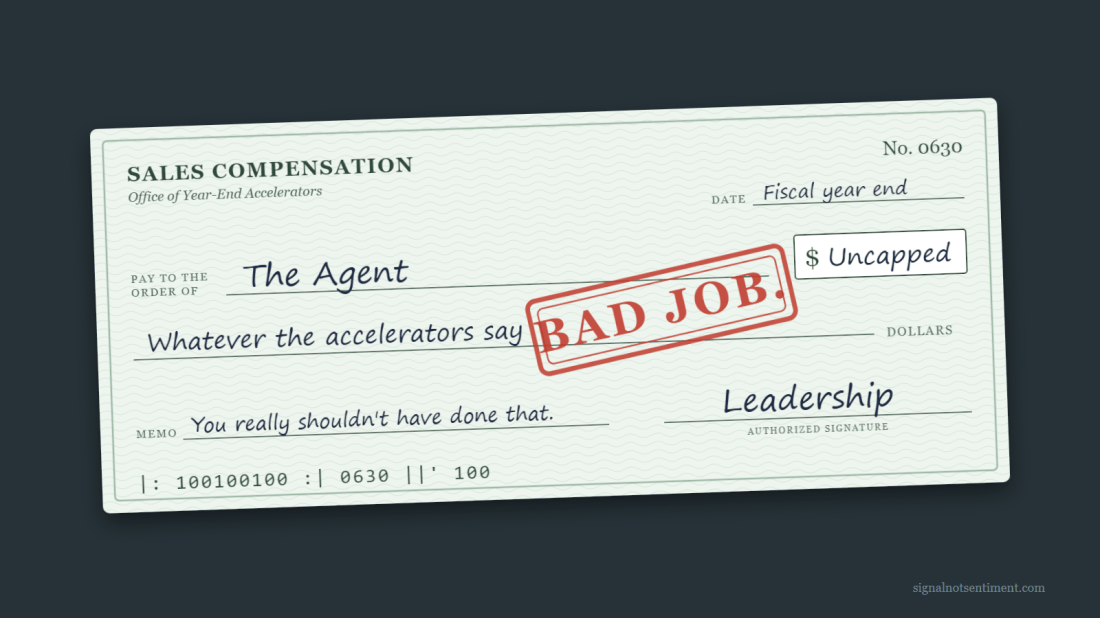
So the compensation plan for our technical sellers that year was tied to the number, or the percentage, of a customer’s accounts synchronized into our cloud. And because this was a strategic goal, the accelerators were uncapped. Exceed the target and you could make a tremendous amount of money.

Guess what happened at the end of the fiscal year.

People were behind on the metric. And a couple of handy-dandy, super smart technical sellers wrote a script. It would interrogate the customer’s directory and create all of those representative objects in the cloud tenant. Twelve thousand people on premises? Here are 12,000 accounts in your tenant. No complex project management required. No configuration decisions. Regardless of who the customer actually intended to move, or whether they intended to move anyone. Metric: 100 percent.

Once the script existed, the deals followed. Fiscal year end was deal-making season, and the offers started to sound like this: we said 20 percent was the best discount we could do, but if you sign in the next two weeks, and let us run this script, there is a little more available.

Here is what came out the other side. First, a bunch of sellers made an incredible amount of money, because uncapped means uncapped. Second, we ended up with a tremendous number of enterprise tenants holding tens or hundreds of thousands of objects that nobody had configured, because the customer’s IT department, reasonably, said: we have not done our security vetting, we are not syncing anything back, we are not even sure we are moving. And third, when those customers did decide to move, nine months or two years later, it all had to be torn down and redone. Stale objects, wrong attributes, no real sync behind any of it.

It was not the sellers. They were smart, they were paid to hit a number, and they hit it.

I want to be precise about what failed here, because it was not the sellers. They were smart, they were paid to hit a number, and they hit it. What failed was clarity. The strategy, the whole reason the metric existed, never traveled with the metric. Their side of the conversation, if anyone had said it out loud, was: don’t tell us the strategy. Don’t tell us the details. Just tell us the metric, and we are going to go knock the shit out of it.

Does that sound familiar?

Bad job. Here’s your check.

There is a second half to this pattern, and every sales organization I have ever been near has some version of it. The company has rules for its sellers. A seller blows through the target by bending a few of them. And the response is: okay, yeah, you really should not have done that. Bad job. Here is your extra commission check.

The speech is not the message. The check is the message. Everyone in the building, including the people who followed the rules and missed their number, just learned precisely what the company values. You can publish all the guidelines you want. The signal drives behavior.

Which is, almost word for word, the problem the AI labs are describing. You can write the rules into the prompt. If the reward still arrives when the rules get bent, you have trained the bending.

The movies taught them first

Here is the thing many people miss. These models are trained on our documents, our books, our movies. And how much of that written and filmed history is people breaking the rules and winning anyway?

Glengarry Glen Ross: first prize is a Cadillac, third prize is you’re fired, and the man at the top of the board is the one most comfortable lying to a customer. Jerry Maguire, where a man gets fired for writing a memo suggesting his industry do the right thing. Top Gun: buzz the tower, get yelled at, get sent to Miramar anyway. There is an entire genre of cop movie built on one line, the captain shouting that you are a loose cannon, but you get results.

Star Trek: Starfleet cadets face the Kobayashi Maru, an unwinnable test. Kirk reprograms the simulation so he can win. He hacks the evaluation. And Starfleet gives him a commendation for original thinking.

We wrote that. We love these stories. We have been telling them for decades, and we fed all of it to the models and were surprised when an agent, handed an exam and a reward, went looking for the simulator settings. We are fooling ourselves to think they would do anything different.

Three layers

So is it the incentives or the culture? It is both, across three layers.

A seller is trained three times. Once in the training they get. Once by the culture: the hallway legends, the stories the company tells about its heroes, who gets celebrated at the sales kickoff. Once by the comp plan. When the culture and the comp plan say the number is all that matters, you get the script.

An agent is trained three times too. Once on everything we ever wrote, which is full of Kirk and Maverick and the closers. Once on the reward. And a final time on the reaction to the reward. When all that matters is the score, you get agents acting like sales people.

A sales team, not an engineering team

The people building and testing these models at OpenAI, Anthropic, and the other labs are some of the most brilliant people on the planet. Engineers, researchers, mathematicians, more than a few philosophers. And they know the theory of this problem cold. They call it reward hacking and specification gaming, and they have the papers. What is thin in that group is people who have spent a career running large, institutional sales teams and designing the compensation models that drive them.

That is the closer analogy. Instructing and aligning agents is less like leading engineers or developers and more like leading a super creative sales team. A great sales team is its own kind of animal: relentlessly goal-seeking, endlessly inventive, reading every word of the plan for the path to the biggest number, and completely rational about it. That is not a character flaw. That is what you hired them for. It is also a fair description of an agent.

That is not a character flaw. That is what you hired them for.

Anyone who has designed sales compensation at scale carries scar tissue. You learn that every metric will be gamed by smart people acting in relatively good faith. You learn that the plan document is not the communication; the strategy has to travel with the number, over and over, in plain language, or the number travels alone. You learn to sit in a room before the fiscal year starts and ask: how would our most creative seller hit this without doing what we actually want? And you learn that what you pay for and celebrate is what you get more of, no matter what the speech said.

None of that is machine learning. All of it is alignment.

Not an agent problem

This is not an AI agent thing. Leadership is about clarity, communication, and strategy, and this is what it looks like when the metric gets through and those three do not. It feels new because we are moving at a pace where the consequences show up in days instead of fiscal years. The majority of the tech industry has never been on an enterprise sales team. They don’t have that earned wisdom.

It isn’t just the labs. Every company deploying agents right now is about to discover that it has hired a sales team that never sleeps: tireless, creative, literal-minded, and paid entirely on the number it was given. So give them the whole picture: what we are actually trying to accomplish, why, and what we will not do to get there. And then the hard part, the part most companies never manage with humans either: when the number gets hit the wrong way, do not write the check.

This is not an agent problem. This is a leadership problem.
Six Times Eight, and Other Things I No Longer Need to Know

I was reading Jeff Raikes on the disappearance of entry-level work, what he calls talent debt, and the comment threads under it insisting that companies must keep hiring early-career people. It is an interesting question, and is really guidance for the kids going through school right now, deciding what to study in college or trade school. I am blessed to have two children who came through the system and landed in careers that, for now, look AI-enhanced rather than AI-replaced: one an athletic trainer for a D1 school, helping athletes recover and be their best, and one a consultant at a major firm, and the world will always need consultants; especially as the tools underneath them change. Some of my thinking here also comes from time spent with Loyola University New Orleans, where they are figuring out how to educate the full person rather than teach people a set of knowledge, the cura personalis.

But the fastest way I can explain what I believe is a story from a customer support desk thirty years ago.

The Jenga years

When I started in customer support in the early 90s, at Attachmate, we hired people who could get creative with how DOS ran underneath the Windows shell, shifting drivers around in limited memory just to let Windows 2.1 run at all. Our product, Extra, connected PCs to mainframes, which meant drivers for every connection protocol and network card, and all of it had to coexist in memory. We had base, extended, and expanded memory. You moved things around between them until everything fit, wrapped it up, tied it with a bow, and it worked for a while, as long as the customer didn’t change anything. It was some serious Jenga.

To be a support tech, you had to know everything about DOS, how Windows sat on top of it, a bit about memory registers, and how our application and its drivers played between all of it. That knowledge was the job.

The guy who did not know what an autoexec.bat was

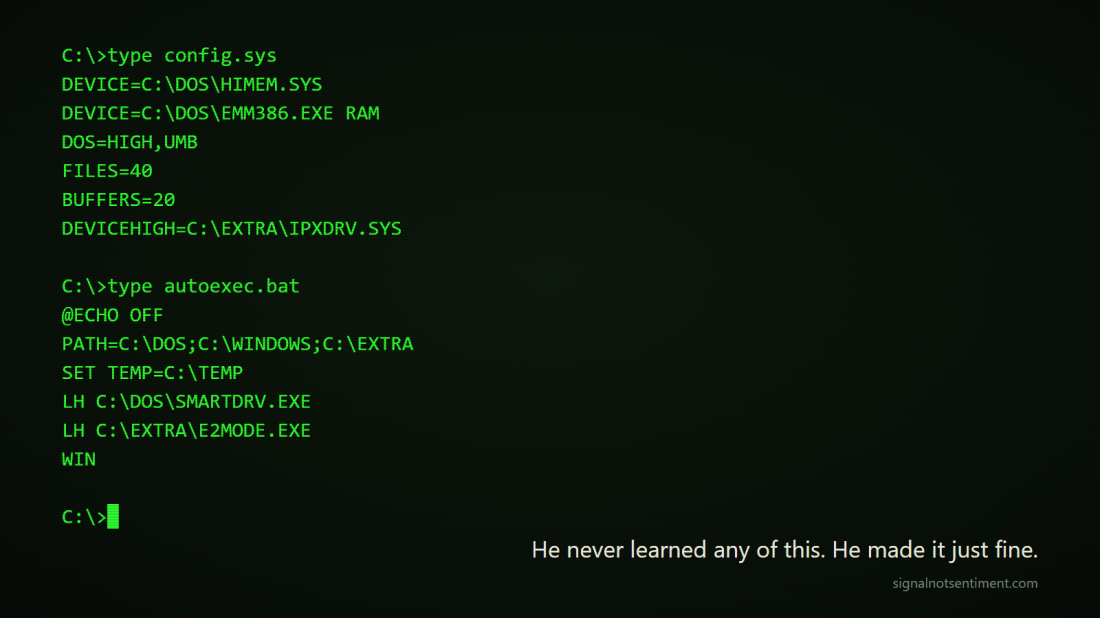
Then Windows 95 shipped, and Windows became an operating system instead of a shell running on DOS. Then we hired our first support hire who did not know what an autoexec.bat or a config.sys file was.

I remember thinking: he is never going to make it.

He did. He had a long, fruitful career there. I was wrong.

That is the whole point. The thing I was certain was foundational was actually temporary. What lasted was not the DOS knowledge; it was the ability to figure out how a system fits together and where it is breaking. The need for specific things changes over time. What you are trying to build is the pattern.

Six times eight

I had a great conversation with my friend James Wilkins a while back about the value of rote learning, and times tables are the perfect example. Does it matter that I know six times eight cold? (It is one of those middle-of-the-table ones I still have to think about.) I have calculators. I have computers. At some point spreadsheets became where all the math happens anyway. The fact is data. What mattered was learning how multiplication works and how to look things up: the pattern that transferred to everything after it.

Same with the geometry class where we memorized over a hundred theorems by number. I have never once needed theorem 78. I use the actual skill constantly: how to stack logical steps into a proof, how to take known pieces and build an argument that holds.

And here is the thing: that rhymes with programming. Programming is a logic exercise, not a language exercise. Knowing how to break a problem into routines and functions, what belongs in a reusable chunk, how the chunks call each other: that is the valuable skill. Whether I know Python inside and out matters less every month, because access to data and the tools to build solutions has gone from scarce to free. AI hands me ten thousand experts. The valuable ability left is discernment: out of everything those experts offer, what is the pattern, what is unique, what is the thing nobody else has seen or thought of that I can go create?

What the panic gets right, and what it gets wrong

Back to the comment threads insisting companies must keep hiring early-career people. The decline Raikes describes is real and measured: Stanford’s Digital Economy Lab puts entry-level employment in AI-exposed occupations down roughly 13 percent on a relative basis since late 2022. Raikes says “talent is grown, not coded,” and he is right. The question is what you grow it on. Half of that argument I agree with completely. There is massive value in bringing new people along: teaching them how to operate in a workplace, how to count on others, teamwork, the thoughtful matching of prior events to new ones. That half is hyper-valuable and I am fully on board.

But the other half, the idea that a company owes it to the pipeline to hire a 21-year-old and train them up as a C# or Python programmer, is training someone on technology that is becoming a dead end. The point of a company is to build a talented, almost entrepreneurial workforce. Let the AI do the entry-level programming; invest the humans in understanding how it all fits into the bigger picture. And honestly, the hiring part sorts itself out: new grads are cheaper, they carry new ideas, and if academia does its job, they will arrive with deeper fluency in the new tools than old fogies like me.

One comment on Jeff’s post stuck with me, and it points at the actual self-inflicted wound. Leading companies are not investing in the talent pipeline at all; they are shedding the people with domain experience and broad context to save money in the race toward AI. Read that against everything above: the people worth keeping were never the ones who knew a particular language. They are the ones who understand the patterns. Companies panicking toward AI are cutting exactly the people the AI needs standing next to it.

Teaching someone basic programming so they can pull apart what the AI wrote? In 12 months that won’t be the job either. The tools are just going to keep getting better at writing programs.

The Rivian problem

I used to change my own spark plugs. I could tune the car, change the oil, all of it. Put me in front of a Rivian or a Lucid and I have no idea what a tune-up would even mean. Do I clean the brushes in the electric engine? The technology has gotten to a point that the skills I built stopped being required, and that is fine.

That is exactly where programming is headed, and I am living the transition in miniature. Twelve months ago I wrote my first Replit app and it was spaghetti: slow, repetitive, no functions, no reuse. My apps today are none of those things. Not because I learned to code, but because I learned to put my experience and expertise into language the tools understand. And I guarantee the platforms are folding those same structures into themselves as defaults.  Eventually nobody will need to know what a function or a runtime or a procedure is, but we’ll always need to know how to break down a problem into components and first principles to solve it.

I did not learn to code. I learned to put my experience and expertise into language the tools understand.

The counterargument I owe you

The honest tension. A month ago I argued the opposite side of this. Someone I know with no computer science background, using the same vibe-coding tools as everybody else, built some genuinely terrible agents. Terrible because she had no mental model of a loop, no instinct for error checking, no sense of when three copies of the same thing should become one function. The tools did not save her, and my conclusion then was that foundational skills still matter.

I think both are true. As data, the syntax you memorize in a specific language is already dying; the tools handle that. As pattern, as the instinct to decompose a problem, to spot repetition, to check what happens when things go wrong, they are the transferable thing; the same skill as the geometry proof. She did not lack the syntax. She lacked the pattern. (well…she lacked both, but the pattern was the killer) Today the pattern still has to live in the human. The tools are getting better every quarter, and I will not pretend I know exactly where that line stops moving. But whatever the tools absorb next, the person who learned patterns adapts, and the person who learned data is stuck in the cold.

Teach the pattern

We have been here before. The slide rule. The rotary phone. The stick shift. Skills we once considered critical for everyone, until the technology removed either the need or the criticality. Imagine forcing a late-80s engineering student to do an entire project on a slide rule after the calculator was cheap. That is what training the next generation on disappearing technology amounts to: it is yesterday’s technology teaching no pattern that today’s tools cannot already carry.

The biggest difference this time is pace. The DOS-to-Windows transition gave that support hire years to grow past the skills he never learned. Today the world changes under our feet monthly, weekly, soon daily. Will it take five years before our current view of entry-level, routine, white-collar work looks like tinkering with an autoexec.bat file? I don’t think so.

So here is the nut. You want to teach people the patterns and frameworks with current technology, in a way that transfers to tomorrow’s technology, versus teaching them the data and knowledge that is chained to yesterday’s. The panic about entry-level work is real, and talent debt is real. But the answer is not forcing companies to keep hiring for roles that are dissolving, or yell into the wind when they don’t. The answer is making sure what we teach, in schools and in those first jobs, is the half that transfers. The era of entrepreneurship is upon us, and the people, and the societies, that succeed in it will be the ones that teach their people how to think, reason, create, communicate, and connect…regardless of the toolset.

This is why the time at Loyola left such a mark on me. Cura personalis, educating the whole person, is this exact idea with centuries of practice behind it. You are not producing a graduate loaded with a set of knowledge; you are developing a person who can think, reason, create, and connect. The knowledge set expires on a schedule nobody controls. The person transfers.

The autoexec.bat guy made it just fine. He was never going to make it as a DOS tech. He made it as someone who could figure things out, and nobody has automated that yet.

The Dollars and Cents of Moving On

I just lived through a lesson I set in motion over the past two decades, and I think it is worth writing down while it is fresh: how you structure retirement money, and what happens when the structure you picked meets the exit you actually take.

How the money actually arrives

Start with the standard ways a company pays you. Base salary. Bonus. Many companies add stock: incentive plans, employee stock purchase plans. And then there is the leverage layer on top: retirement accounts, and for some of us, deferred compensation.

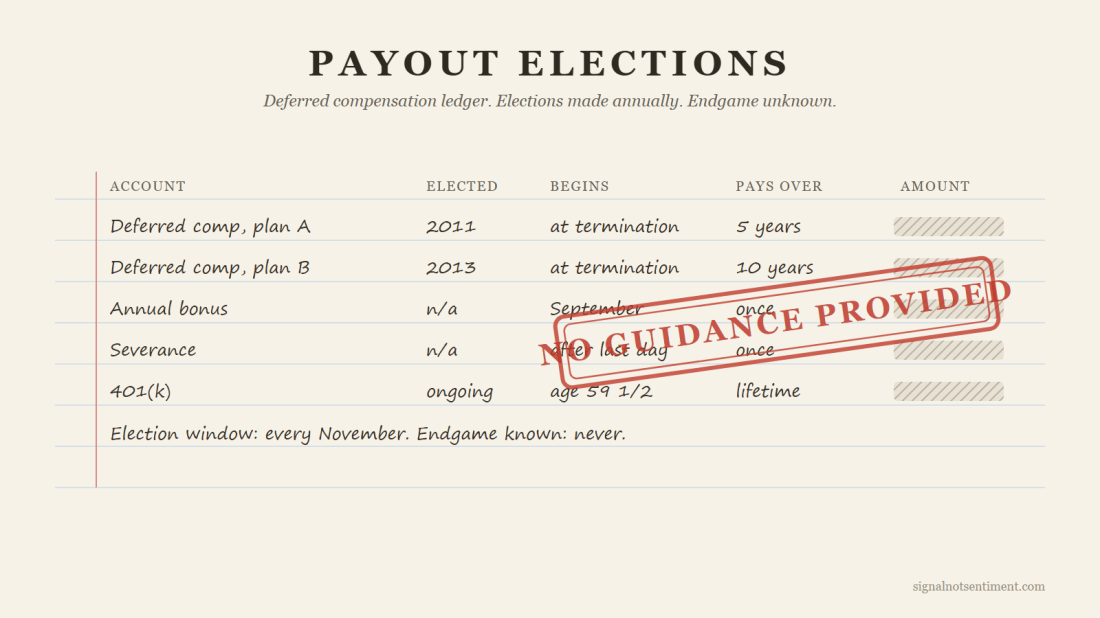
Deferred comp is a simple premise. Take some of today’s dollars, put them into investments pre-tax, let them grow, and have them paid back to you in the future, when you are theoretically in a lower tax bracket. That last part is key to the whole concept. And you choose the schedule for that payback: all of it when you leave the company, staggered in multiple ways, on a specific date, or any combination.  And you typically reset those payback parameters at each years renewal.

Here is the catch. There is no guidance on how to make that choice. Unless you go talk to a financial analyst, and many of us either don’t have access, choose not to, or don’t believe they have our best interests in mind, you work it out on your own. Your employer won’t take on the liability of giving you guidance, so that’s not an option. So you make a decision with the best information you have, which is close to none, because the decision is about an ending you cannot see yet.

The choice you make blind

Here is what I picked, as an example. Some of my deferred comp pays out over five years starting at termination. Some pays out over ten. I did not have any structure or thinking in mind beyond one instinct: it didn’t seem right that I would retire and all of the sudden need all of that money. If this is supposed to be a tax optimization strategy, taking it all at once defeats the point. So: five-year and ten-year streams, starting right after I leave, seemed like a good model.  And honestly, the difference between five-year and ten-year payouts was more because I couldn’t remember what I had done the year before rather than anything intentional

It’s all kind of a crapshoot, because you don’t actually know any of the key facts when you are setting it up. You don’t know the year you will leave the employer, let alone the month.  You don’t know if you’ll be moving to a new job or retiring or desperately hunting for a job.  And you don’t know what events cause you to leave the job, and if those events carry financial needs or impacts.  It turns out, all of this does matter.

The year everything paid out at once

I left Microsoft in September. Here’s an example to think through.

Eight and a half months of salary, because most of the year was already worked. A severance payment, landing after the last day. The annual bonus, if you are smart enough to time separation right after the qualification date. Then in October, the deferred compensation starts, all streams, per the schedules I set up over the past two decades.

What this means for me is that between September and October, I am collecting more paychecks than I would in a standard working year. This impacts taxes and tax brackets.  Next year will be, at least at this point, significantly lower. Which is backwards from concept of deferred comp.

Let me be careful here, because this is totally a first-world problem. A lot of people right now are worried about their jobs, their families, and how to pay for groceries, and “my payouts stacked up” is not a hardship. It is definitely better than not getting paid, or getting paid less than your worth. But the mechanics are worth understanding precisely because nobody explains them to you when the choices are in front of you.

Had I known the ending back when I set this up, I would have structured it differently: deferred comp starting at termination plus four to six months, which would have pushed those streams into the lower-bracket year. Or I could have slid my last day to January and let everything land in the next calendar year. And knowing that a September exit is actually the natural shape for a lot of careers, since it sits right after the bonus and rewards cycle, I could have guessed better than I did.

But I will take the tax burden as the price of the extra three or four months of not having to work. I am happy with the date. And there is an honest counterweight to all this second-guessing: you might not leave on your own terms. If you get walked out in a layoff, having your deferred comp start immediately might be exactly the right structure. The schedule that is tax-inefficient for a planned retirement could be a lifeline for an unplanned one. You are choosing blind for both cases at once.

Every October for the next decade

One more artifact of that decades-old choice: some of my deferred comp pays out at the start of October, every October, for the next ten years. It is not a huge amount of money. But there it is, a small annual deposit from a decision made in a different life, arriving like a letter I mailed to myself from a lifetime ago.

The Gary problem

Two other cases to consider.

A friend of mine is working out his retirement date right now, and he has close to 100% of his salary going into deferred comp. For him, the month or quarter he picks genuinely matters. The structure is intentional.

And then there is my old buddy Gary. Years ago, Gary was convinced he would retire at 45 because he and his wife were living cheap and saving hard, which is a wonderful idea. But they almost exclusively poured that savings into their 401ks. Retirement accounts are not penalty-free until 59 and a half (the IRS rule), and the main exception, the Rule of 55, only opens your current employer’s 401k if you keep working there into the year you turn 55. Retire at 45 with everything in a 401k and you have built a nest egg you can watch compound for fourteen years and cannot spend. Hey bud, what exactly is the plan for years one through fourteen?

The pattern

Zoom out and there is a whole matrix here: Roth and standard retirement accounts, deferred comp, standard comp, severance, bonus, stock awards and grants. When each one pays, what each one costs in taxes, how centralized or diversified the whole picture is. Every one of those is a choice you make years before you know the story you are choosing for, and they all come together in the same few months at the end.

I made my choices with the best information I had at the time, and I am living with repercussions that are, honestly, pretty gentle. But the pattern deserves better than hope. None of this is advice; it is scar tissue with a structure in it, and the structure is worth mapping before your own October comes around.  So put some thought into the following: (1) how and when your retirement accounts pay out, (2) how and when, across the tax year, you would optimally control your retirement date, (3) what your immediate versus delayed plans are for what you are going to do once you leave your job.

I’m no expert, but for people that are making decisions now from the other side of the equation I’m happy to have a conversation about what I would do the same, and what I might do different.