Thanks to Makoto Eyre I’ve been reading The World for Sale, the Javier Blas and Jack Farchy book about the commodity trading houses. It confirms one of my core beliefs: the most reliable way to make money is inequality of information.
Think about how traders actually make their money. I know something about the wheat harvest in the Americas that you do not, because I did more research, or I bought better satellite imagery, or I have people on the ground. So I buy or sell the futures and take the spread between what I know and what the market knows. Oil was the giant version of this: a huge boom in demand layered over massive inequality in supply, demand, market access, and even basic knowledge of who had what kind of crude where. The traders who closed those information gaps, one contract at a time, made billions doing it.
Here is the thing though. My drive in understanding this is not to recreate the commodity traders’ billions. Technically, I wouldn’t turn that down, but okay, whatever. My drive is the opposite trade: find where the inefficiencies of the market are, because if you can balance the inequality of information, if more people can see what only the traders used to see, the frictional cost that gets skimmed off every transaction shrinks. And when the friction disappears, the end product gets cheaper. That is the whole arc: equal information leads to efficient markets leads to cheaper everything. The traders monetize the gap, and the consumers pay.
The newest inefficient market
Hold that principle and look at AI.
The demand explosion is not one market, it is a whole stack of them: compute itself, the chips that produce it, the racks and components that fill the data centers, the data centers themselves, the interconnect that ties them together, and the power that feeds all of it. Every layer of that stack is running hot with demand, and every layer is full of exactly the kind of information inequality the commodity traders would recognize from a hundred yards away. Who has capacity, who needs it, what an H100 hour actually clears at today versus what you are quoted: that spread is where the friction lives.
So the natural question becomes: does this stack get commoditized, and who builds the market?
It’s already happening
That question walked straight into an episode of the Moonshots podcast I was listening to (episode 278), which features Kush Bavaria, the 23-year-old co-founder and CEO of a company called Ornn. What Ornn is building is the infrastructure to trade AI compute as a commodity: live price indices across the GPU rental market, tracking what an hour of H100 or B200 actually costs, and the financial plumbing on top.
It is live today, in an early form. You can already take positions on GPU compute prices on Kalshi against Ornn’s index, though honestly the market there is thin: you can bet where the price of GPU compute lands at the end of a month, but there is no real futures market yet, no serious hedging instrument. That is coming. Ornn is working on cleared compute futures with Intercontinental Exchange, and Kalshi’s own CEO is now calling compute “the new oil” and racing to build the forward curve.
Sit with the shape of that for a second. The book on my nightstand is about the last century’s masters of information inequality. The podcast in my ears is about this decade’s attempt to build the exchange where compute trades like wheat. My brain went immediately to the space between them.
Steeper than oil
Here is the part that has my attention. Go look at oil’s actual price history. In 1970, a barrel went for about three dollars. The 1973 embargo quadrupled it to twelve in a matter of months, and the world treated that as a full-blown crisis. By 1980 it had touched the mid thirties, and $25 oil, a number that would have been unheard of a decade earlier, was suddenly the floor. Then in 2008 it spiked to $147, and has never looked back. This spring it spiked to $120, and today it trades near ninety: three and a half times that unheard-of number, and almost thirty times over what for years was “normal”. That is what it looks like when a demand curve outruns the market’s ability to organize supply.
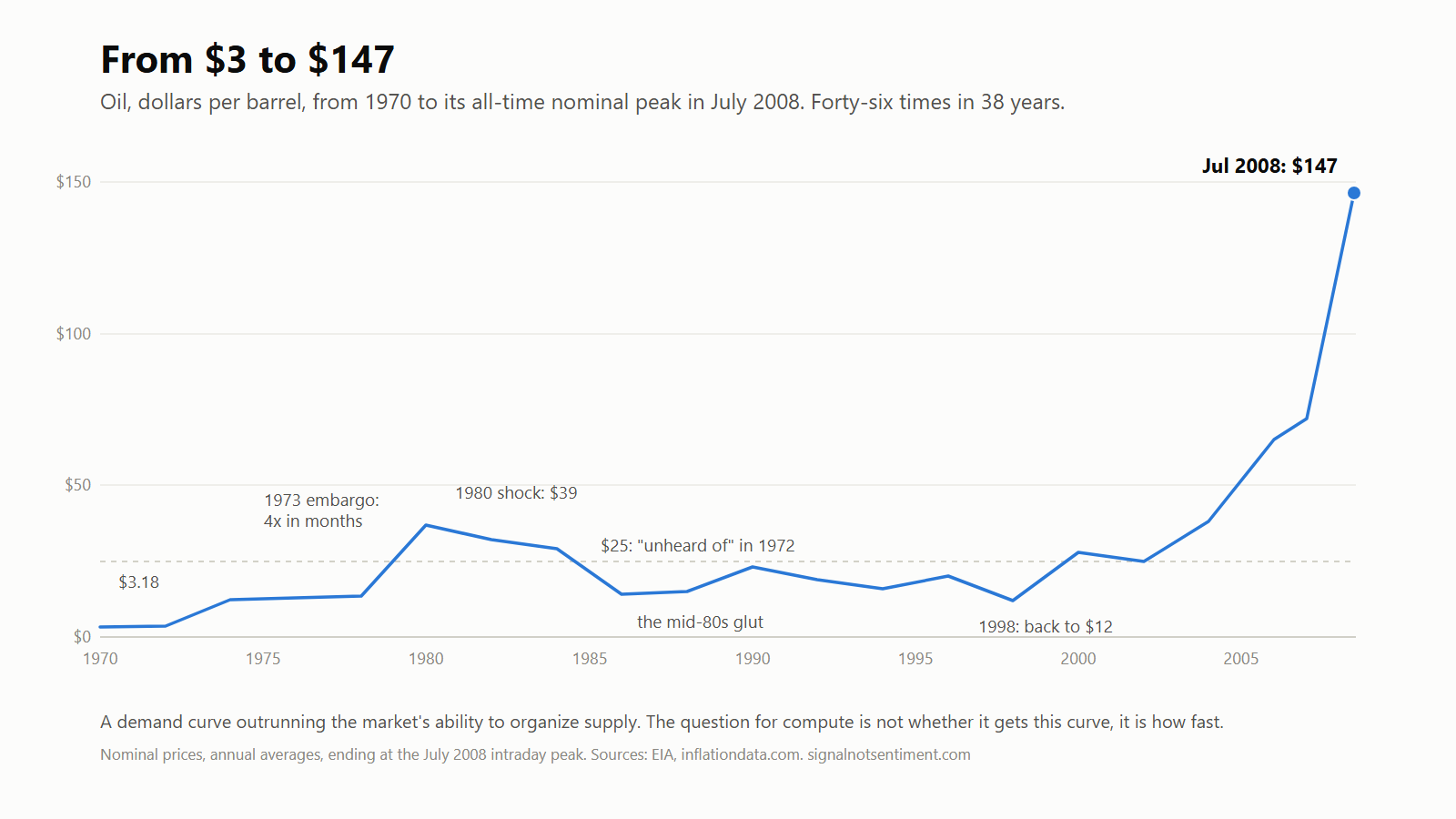
My big takeaway: the demand curve for compute is accelerating faster than the demand for oil ever did. Oil demand grew with economies and new industries, a few percent a year, and still produced shocks. Compute demand compounds with the AI buildout itself. Every model generation, every data center, every agent deployment adds load, and the buildout is speeding up, not settling. By January we’ll be seeing a new model release every day. The price signal is already twitchy in a way oil took decades to become: an hour of B200 compute peaked at $6.11 at the end of May and traded at $4.22 three weeks later, a 31 percent move in under a month. Oil needed an embargo to move like that. Compute did it in a normal June.
A market with that demand curve, that volatility, and no futures curve yet is the purest information-inequality setup since the tanker traders of the seventies. The people with better information about capacity, load, and power are going to take trader profits out of it. Which is exactly why the equalizing infrastructure, the public price, the index, the forward curve, matters more here than it ever did for oil. The steeper the demand curve, the bigger the frictional cost of unequal information, and the bigger the payoff for everyone downstream when that information gets equalized.


